By 1995 I had already been creating exhibitions and interventions that involved cutting into buildings and architectural spaces. Earlier projects had taken place in Leytonstone (1994) and at the British Museum (1995). At the same time, I was becoming increasingly interested in developing work specifically for gallery contexts.
I was intrigued by the idea of creating a body of work using ordinary materials. I was determined not to bring too much into the gallery space because, in a sense, the gallery itself was the material. The idea of site-specificity was central to my thinking.
One of the recurring concerns in my work has always been the use of basic, everyday objects and materials. As a painter, I often used a heavy-duty staple gun to stretch and secure canvas onto wooden frames. The force of the staples penetrating the wood — the sound, the impact, the physical action — became increasingly compelling to me.
When I was invited by the Cafe Gallery in London to make a new project, I began thinking about how I could extend these ideas. Although the work differed from my earlier architectural cuts, it still involved penetrating the wall in some way — though not cutting through it entirely.
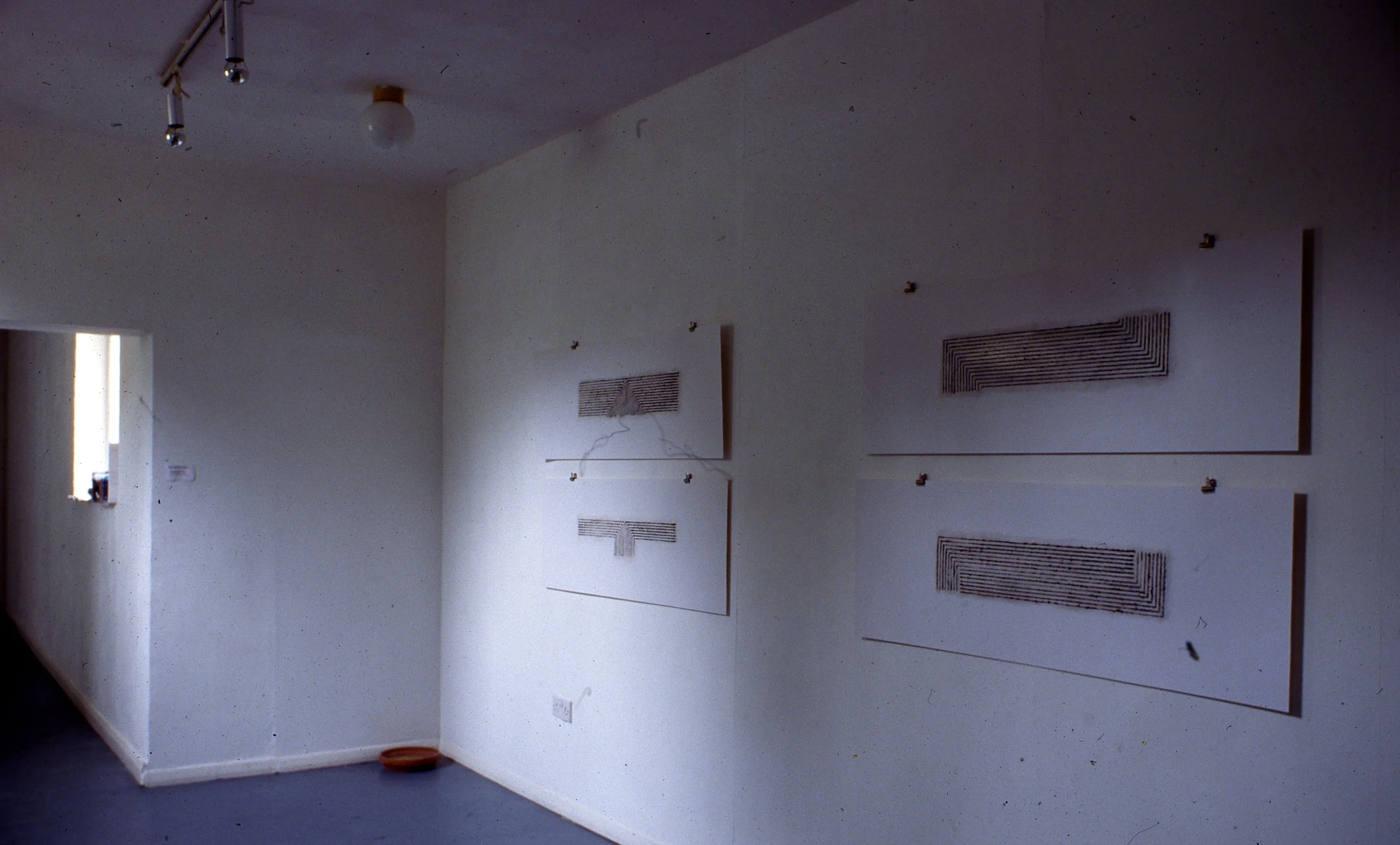
I adapted my staple gun so that the staples would not fully embed themselves into the wall, but instead protrude slightly from the surface. Before beginning the installation, I made a series of preparatory drawings that mapped out the eventual form of the piece.
Once in the gallery, I measured the wall carefully and marked out the oblong shape that would define the work. I then began firing staples into the surface. In the end, the installation consisted of approximately 12,000 staples.
As the work developed, the repeated impact and vibration of the staple gun caused the wall itself to deteriorate. A crack gradually appeared through the centre of the piece. At the time, this imperfection felt significant — not only in relation to the work itself, but also as a reflection of the political and social climate of the period.
Britain was still under John Major’s Conservative government, a time overshadowed by political scandal and instability. Internationally, conflicts such as the war in Bosnia dominated the news, while rapid changes in culture and media created a sense of fragmentation and uncertainty. The title Imperfect State emerged from this atmosphere.
Politics has always informed my work. I came from a firmly left-wing perspective, yet even the Labour Party, then regrouping under Tony Blair, was beginning to transform into something I barely recognised politically — a rebranded and revitalised version of conservatism.








The Landscape in the United Kingdom
1. Political Landscape: A Dying Regime & The Rise of "New Labour"
Tory Decay: The Conservative government under John Major was plagued by internal sleaze scandals, deep divisions over the European Union, and a dwindling parliamentary majority.
The Leadership Challenge: Major famously resigned as party leader in June to issue a "put up or shut up" challenge to his eurosceptic critics, narrowly winning re-election.
The Labour Juggernaut: Under Tony Blair (who became leader in 1994), "New Labour" modernized its image, abandoned its traditional socialist clause on public ownership, and held an insurmountable lead in the polls.
Royal Turmoil: The Royal Family dominated headlines when Princess Diana gave her bombshell Panorama interview. In December, the Queen formally urged Charles and Diana to divorce.
2. Cultural Landscape: Britpop and Creative Optimism
The Battle of Britpop: In August 1995, the charts exploded into national news with the head-to-head single release between working-class northern heroes Oasis ("Roll With It") and middle-class southern rivals Blur ("Country House"). Blur won the week, but Oasis's seminal album (What's the Story) Morning Glory? went on to define the decade.
Cool Britannia: London was dubbed the cultural capital of the world. This boom spanned the music of the Spice Girls (then forming), fashion, and the shock-art tactics of the Young British Artists (YBAs) like Damien Hirst.
Social Undercurrents: Beneath the optimistic pop music, serious social friction remained. Racial tensions were high following the unprosecuted 1993 murder of Black teenager Stephen Lawrence, and December saw major riots erupt in Brixton.
🌍 The Global Landscape
1. Political Landscape: Post-Cold War Conflict and Peace Efforts
Balkan Horrors and Peace: The Bosnian War saw its darkest hour in July with the Srebrenica massacre, prompting NATO airstrikes. This culminated in the Dayton Peace Accords in December, bringing an end to over three years of brutal warfare.
Middle East Devastation: Optimism for the Israeli-Palestinian peace process was shattered in November when Israeli Prime Minister Yitzhak Rabin was assassinated by a right-wing Jewish extremist.
Rise of Domestic Terrorism: The United States suffered what was then its deadliest domestic terror attack when anti-government extremists bombed a federal building in Oklahoma City, killing 168 people.
The Tokyo Subway Attack: In March, the apocalyptic Aum Shinrikyo cult released deadly sarin nerve gas into the Tokyo subway system, killing 13 people and altering global views on counter-terrorism.
2. Cultural and Technological Landscape: The Digital Dawn
Windows 95: In August, Microsoft launched Windows 95. Featuring the debut of the "Start" menu and built-in internet support, it triggered mass consumer adoption of personal computers and the mainstreaming of the World Wide Web.
The PlayStation Era: Sony released the PlayStation console globally in September. It revolutionized the gaming market, transforming video games from a children's hobby into an edgy, mainstream youth culture phenomenon.
The O.J. Simpson Trial: In October, an estimated 100 million people globally tuned in to watch the live verdict of the "Trial of the Century," exposing deep racial polarization and pioneering modern 24-hour reality television news cycles.
Cinema Transformation: Pixar released Toy Story, the world's first fully computer-animated feature film, fundamentally altering the trajectory of Hollywood animation forever.
